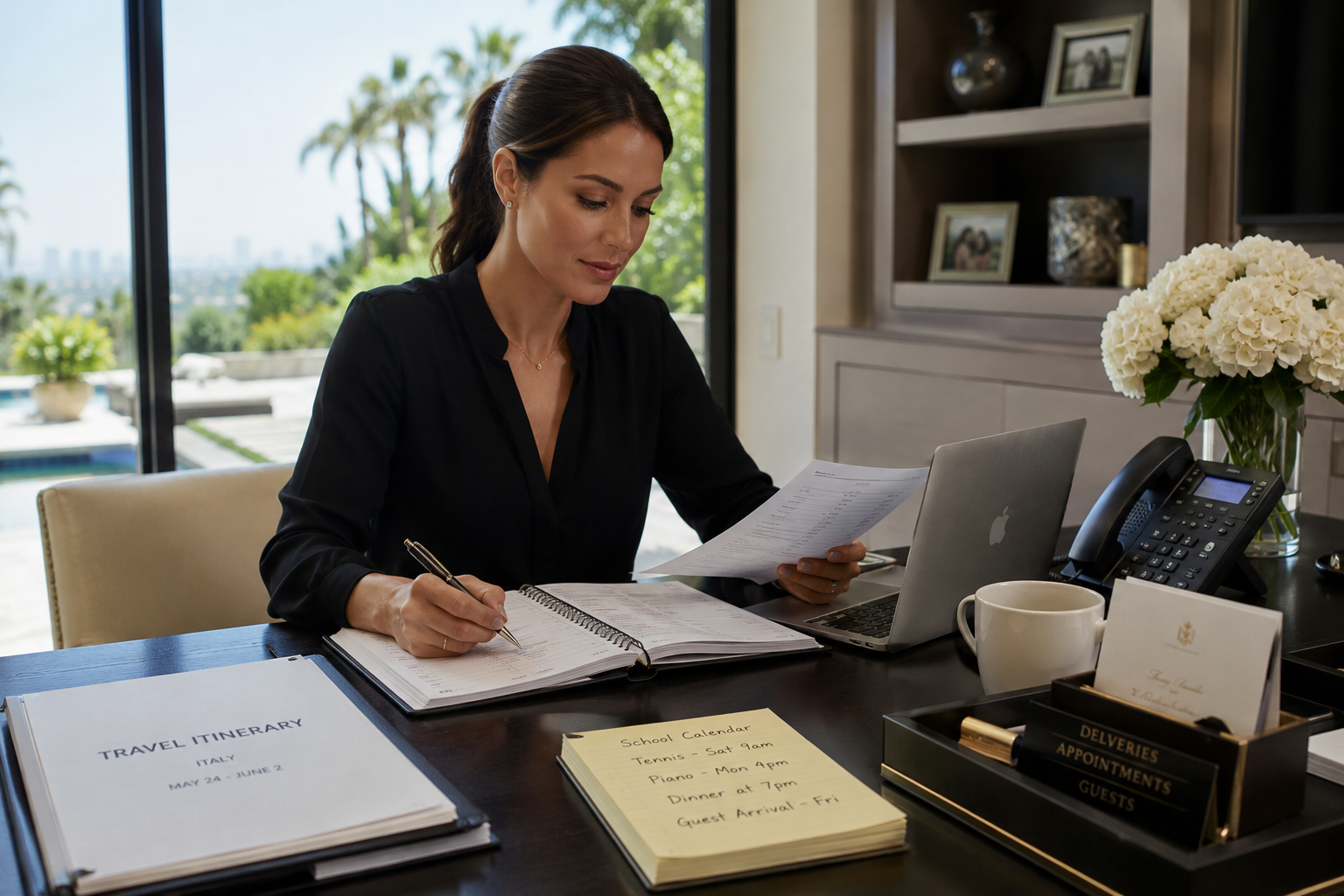
A luxury household may have an Estate Manager, a Chef, Housekeepers, a Nanny, a Chauffeur, and trusted vendors.
Yet even with an excellent team, the family’s personal and household schedules can remain overwhelming.
Appointments change. Guests confirm at the last minute. Children have competing activities. Deliveries need coordination. Travel documents must be prepared. Gifts must be purchased. A repair appointment overlaps with a family event. A residence needs to be ready sooner than expected.
The Personal or Family Assistant connects these moving pieces.
In a modern Los Angeles household, this professional often becomes the operational link between the family’s private life and the team responsible for supporting it.
What Does a Personal or Family Assistant Do?
The position is highly customized.
A Personal Assistant may focus primarily on one individual, managing their calendar, travel, errands, appointments, correspondence, and personal projects.
A Family Assistant generally supports the wider household, coordinating schedules, children’s logistics, household tasks, travel, and communication with staff.
Depending on the family’s needs, responsibilities may include:
Managing personal and family calendars
Scheduling appointments
Coordinating travel
Organizing household deliveries
Running errands and purchasing gifts
Maintaining contact lists
Managing invitations and RSVPs
Coordinating children’s activities
Communicating with household staff
Supporting events and guests
Tracking personal projects
Organizing wardrobes and packing
Handling returns and exchanges
Maintaining household records
The most effective role is built around the family’s real routines rather than a generic list of tasks.
Creating Order Across Complex Schedules
Los Angeles family schedules can involve school, work, wellness appointments, social commitments, travel, events, and multiple residences.
The Family Assistant helps create one reliable source of information.
They may maintain:
Individual and shared calendars
School and activity schedules
Staff schedules
Travel itineraries
Guest plans
Vendor appointments
Medical and wellness appointments
Vehicle and driver requirements
Important renewal dates
Personal reminders and deadlines
They also identify conflicts before they become problems.
For example, an appointment in Beverly Hills may affect a school pickup in Brentwood. An evening event may require additional childcare and a later driver schedule. A property arrival may need to be coordinated with housekeeping, the Chef, and security.
The Family Assistant sees how each decision affects the wider household.
Coordinating Travel From Beginning to End
Travel support extends beyond booking transportation and accommodations.
A Personal or Family Assistant may coordinate:
Flights and private aviation details
Ground transportation
Passports, visas, and documentation
Accommodation confirmations
Packing and wardrobe preparation
Children’s travel needs
Pet arrangements
Medication and wellness items
Household arrivals and departures
Staff travel
Restaurant and activity reservations
Luggage transfers
Changes to the itinerary
They may also communicate with the team at the destination property to ensure rooms, vehicles, food, clothing, and personal items are ready.
The family receives one organized itinerary, while the assistant handles the network of details behind it.
Connecting the Family With Household Staff
A Personal or Family Assistant should complement—not replace—the Estate Manager or House Manager.
The Estate Manager oversees the property and staff operation. The Family Assistant focuses more closely on the family’s personal requirements.
The two positions may collaborate on:
Daily schedule changes
Guest arrivals
Meal requirements
Vehicle coordination
Family travel
Household events
Deliveries
Children’s activities
Personal shopping
Property transitions
Clear boundaries prevent duplicated work and ensure that instructions reach the correct member of staff.
For example, the Family Assistant may inform the Estate Manager that guests are arriving. The Estate Manager then coordinates housekeeping, service, security, and property preparation.
Supporting Children Without Replacing the Nanny
In households with children, the Family Assistant may help manage the administrative side of family life.
This can include:
Maintaining school calendars
Registering for activities
Coordinating tutors and coaches
Purchasing uniforms or supplies
Organizing birthday gifts
Confirming appointments
Communicating approved schedule changes
Preparing activity bags or travel items
Coordinating transportation
However, this is different from providing primary childcare.
A Nanny or Manny is responsible for direct care, supervision, development, and the child’s daily well-being. A Governess may focus more heavily on education and etiquette. The Family Assistant supports the schedule and logistics around these roles.
Defining this distinction is essential when hiring.
Managing Personal Purchases and Household Details
Many tasks assigned to a Personal Assistant may appear small individually but consume significant time when combined.
Examples include:
Sourcing a specific gift
Arranging returns
Coordinating tailoring
Reserving a restaurant
Replacing a personal item
Preparing thank-you notes
Tracking an important delivery
Organizing a closet
Scheduling a beauty or wellness appointment
Preparing items for travel
Researching a service provider
An exceptional assistant completes these tasks accurately while learning the family’s preferences.
Over time, they understand preferred brands, sizes, vendors, communication styles, gifting habits, and decision-making thresholds. This knowledge allows them to act efficiently without seeking approval for every routine detail.
Discretion, Boundaries, and Trust
The Personal or Family Assistant may have access to highly sensitive information.
This can include:
Calendars and locations
Personal contacts
Travel documents
Family correspondence
Purchases and financial details
Medical appointments
Information about children
Private events and relationships
The candidate must demonstrate mature judgment and strong professional boundaries.
Confidentiality also involves careful digital practices. Personal information should be stored securely, shared only with authorized people, and removed from personal devices when appropriate.
Trust should be supported by clear systems rather than informal assumptions.
What Makes a Strong Personal or Family Assistant?
The best assistants combine warmth with precision.
They should be approachable enough to work closely with the family, yet professional enough to maintain boundaries and operate confidently with household staff, vendors, schools, offices, and guests.
Important qualities include:
Exceptional organization
Strong written and verbal communication
Comfort with changing priorities
Excellent follow-through
Technology confidence
Resourcefulness
Emotional intelligence
Good judgment
Awareness of household hierarchy
Absolute discretion
A successful assistant also understands the difference between being proactive and overstepping.
They anticipate what will be useful, but they do not make sensitive decisions without appropriate authority.
Personal Assistant, Family Assistant, or Executive Assistant?
These positions can overlap, but each has a different emphasis.
A Personal Assistant generally supports an individual’s private life.
A Family Assistant supports shared family schedules, household logistics, children’s activities, and personal tasks.
An Executive Assistant primarily supports professional responsibilities such as business calendars, meetings, correspondence, and corporate travel.
Some households require a hybrid role, particularly when personal and professional commitments are closely connected. However, combining too many responsibilities can make the position unmanageable.
Before hiring, the household should determine:
Who the assistant will support
Whether the work is primarily personal or professional
How much childcare-related coordination is required
Whether the assistant will work from the residence
Whether travel is expected
Which decisions they may make independently
Who they report to
How they interact with the household team
A detailed job description creates realistic expectations for both the family and the candidate.
Giving the Family Back Its Time
The true value of a Personal or Family Assistant is not the number of tasks completed.
It is the mental space they create.
The family no longer has to remember every deadline, coordinate every appointment, follow every delivery, or connect every person involved in the day. The assistant organizes those details into a clear, dependable system.
At Heritage Estate Management, we carefully assess each household’s lifestyle, schedule, existing staff, and expectations before beginning a search. This allows us to identify Personal and Family Assistants who offer not only excellent skills, but the right personality and judgment for the home.
Contact Heritage Estate Management to find a Personal or Family Assistant who can bring greater organization, continuity, and ease to your Los Angeles lifestyle.