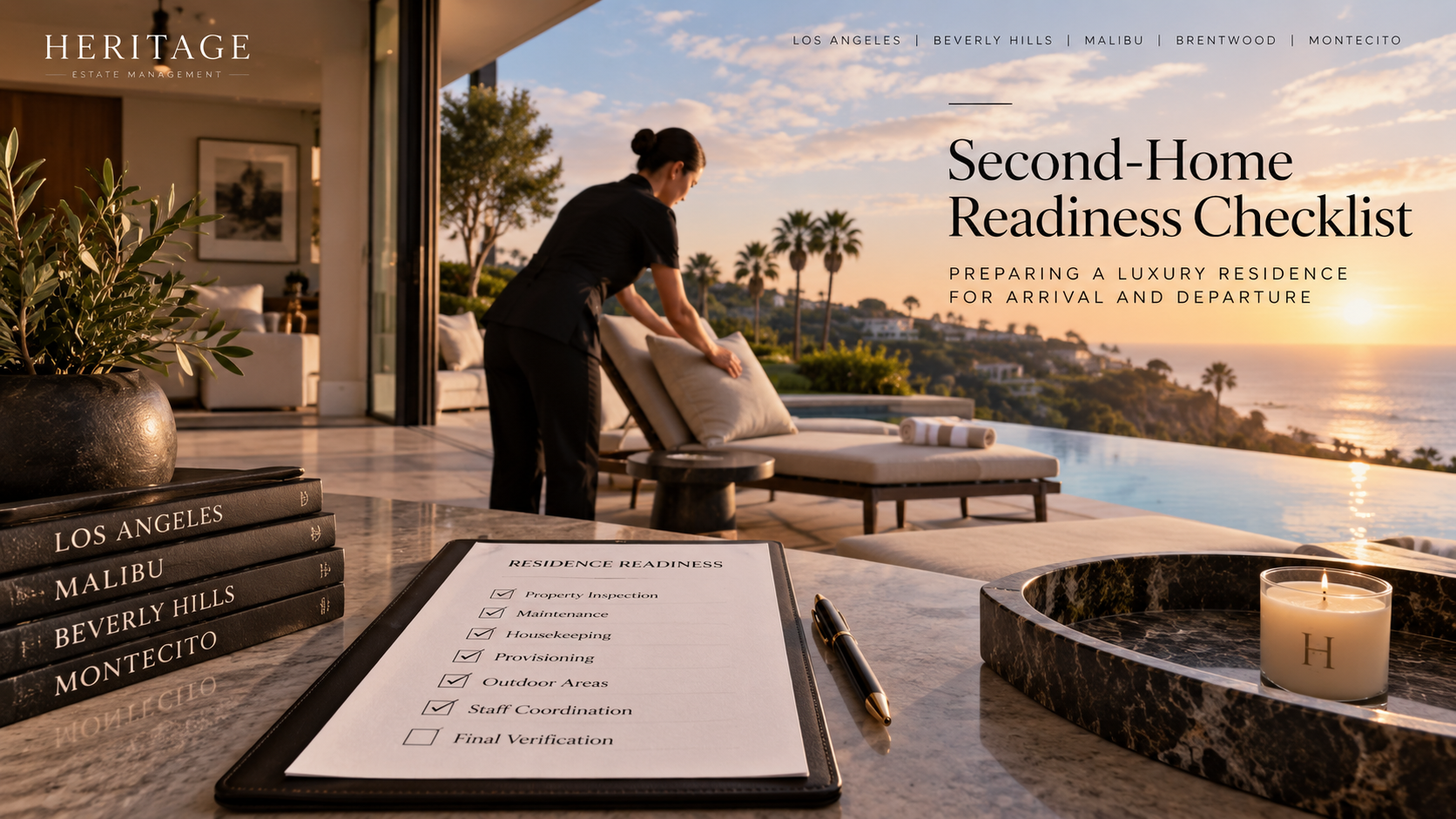
A second home should feel ready the moment the owner arrives.
That requires more than cleaning the property before a visit. Effective residence readiness means coordinating the home, staff, vendors, supplies, maintenance, and unresolved issues through a repeatable process—with clear responsibility for every task.
For owners who divide their time between multiple residences, that structure can make the difference between arriving at a property that needs attention and arriving at a home that is ready to enjoy.
Start With the Upcoming Stay
Every arrival is different.
A quiet weekend requires different preparation from a month-long stay, a family gathering, or several days of entertaining.
Before preparing the residence, the household team should confirm:
Expected arrival and departure dates
Number of family members and guests
Rooms that will be occupied
Planned entertaining or events
Transportation requirements
Household provisioning requests
Any maintenance or vendor work that must be completed before arrival
This gives staff and vendors one clear operating plan instead of relying on assumptions.
Step 1: Complete a Property Walkthrough
Residence preparation should begin with the property itself.
Before focusing on presentation, someone should inspect the residence and identify anything that could affect the owners' stay.
The walkthrough may include:
Interior and exterior condition
HVAC performance
Visible plumbing concerns
Lighting
Major appliances
Pool and spa areas
Landscaping and irrigation
Gates and access systems
Frequently used household equipment
Any issue found during the inspection should have three things attached to it:
An owner. A deadline. A verification step.
Finding a problem is only the beginning.
Residence readiness means making sure someone is responsible for resolving it.
Step 2: Coordinate Outstanding Maintenance
Maintenance work should be reviewed early enough to avoid unnecessary disruption after the owners arrive.
If a vendor is required, the Estate Manager or responsible household team member can coordinate the appointment, property access, scope of work, and follow-up.
After the service visit, the important question is not simply:
Did the vendor come?
It is:
Was the issue actually resolved?
Completed work should be checked and any remaining problem documented.
Step 3: Prepare the Interior
Once the residence itself has been inspected, the household can move into presentation and comfort.
Depending on the property and owner preferences, preparation may include:
Housekeeping throughout occupied areas
Preparing bedrooms and bathrooms
Refreshing linens
Checking frequently used appliances
Restocking household essentials
Preparing guest rooms
Organizing living and entertaining spaces
The objective is consistency.
Owners should not need to rediscover small household problems every time they return.
Step 4: Provision the Residence
Provisioning should reflect the upcoming stay rather than simply repeating an old shopping list.
Preferences change.
Guest counts change.
Schedules change.
A useful provisioning process should therefore begin with current instructions.
This may include groceries, beverages, toiletries, household products, flowers, pet supplies, children's items, or other requested essentials.
For households with documented preferences, an established household manual can make preparation faster while still allowing staff to update the list for each visit.
Step 5: Prepare Outdoor Areas and Amenities
For many Southern California residences, outdoor areas are an important part of the owner's experience.
Before arrival, the responsible team member should verify that relevant areas are clean, functional, and ready for use.
Depending on the residence, this may involve:
Pools and spas
Outdoor furniture
Patios and terraces
Landscape presentation
Outdoor kitchens
Exterior lighting
Recreational areas
Again, the objective is not simply appearance.
Equipment expected to be used should also be operating properly.
Step 6: Confirm Staff Responsibilities
A beautifully prepared property can still feel disorganized if the household team does not know what happens next.
Before arrival, responsibilities should be clear.
Who handles housekeeping during the stay?
Who coordinates vendors?
Who manages household supplies?
Who receives maintenance requests?
Who communicates important issues to the owner?
Clear roles reduce duplicated work and prevent important tasks from falling between employees.
For more complex residences, professional private estate and property management can provide the central coordination required to keep these responsibilities organized.
Step 7: Perform a Final Verification
The final walkthrough should not simply repeat the first inspection.
Its purpose is to confirm that preparation is actually complete.
That means verifying that identified problems have been addressed, required supplies are present, rooms are ready, vendor work is finished, and no unresolved issue is likely to surprise the owner upon arrival.
If something cannot be completed, it should be communicated clearly.
A known issue is easier to manage than an unexpected one.
A Simple Residence-Readiness System
A useful checklist can be organized around four questions:
TaskQuestionResponsibilityWho owns this task?DeadlineWhen must it be completed?VerificationHow do we confirm it is finished?Follow-upDoes anything remain outstanding?
This simple structure transforms a checklist from a collection of reminders into an operational system.
Departure Needs Its Own Checklist
Residence management does not stop when the owners leave.
The property now needs to transition from occupied mode back to its normal operating condition.
After departure, the team may need to:
Reset bedrooms and living areas
Manage perishables and household supplies
Complete laundry and housekeeping
Document damage or maintenance concerns
Record requests made during the stay
Adjust staff schedules
Schedule necessary vendor work
Update household inventories
Prepare the property for the next period of vacancy
This is also the ideal time to capture information that can improve the next arrival.
Turn Each Stay Into Better Information
Every visit teaches the household something.
Perhaps a product needs to be stocked in greater quantities.
Perhaps a piece of equipment requires recurring attention.
Perhaps the family requested a different room setup.
Perhaps a vendor issue revealed a weakness in the maintenance schedule.
Those details should not disappear after the owners leave.
Updating the residence-readiness process creates a system that becomes more accurate over time.
Managing Readiness Across Multiple Residences
Multi-property households need consistency without assuming every residence operates identically.
A Beverly Hills estate may have different requirements from a Malibu residence or a property in another region.
The individual checklist should reflect the property.
The management standard should remain consistent:
Inspect. Assign. Complete. Verify. Report.
That creates a predictable experience for the owner even when the homes themselves are very different.
The Best Arrival Is an Uneventful One
Professional residence readiness is successful when the owner barely notices it happened.
The home is comfortable.
The property is functioning.
Supplies are available.
Staff understand their responsibilities.
Outstanding work has been completed or clearly communicated.
The owner can simply arrive and use the residence as intended.
Heritage Estate Management provides private estate and property management for luxury residences, second homes, and multi-property households, including property oversight, vendor coordination, residence readiness, and household operations.
Contact Heritage Estate Management to discuss a residence-readiness plan for your home.