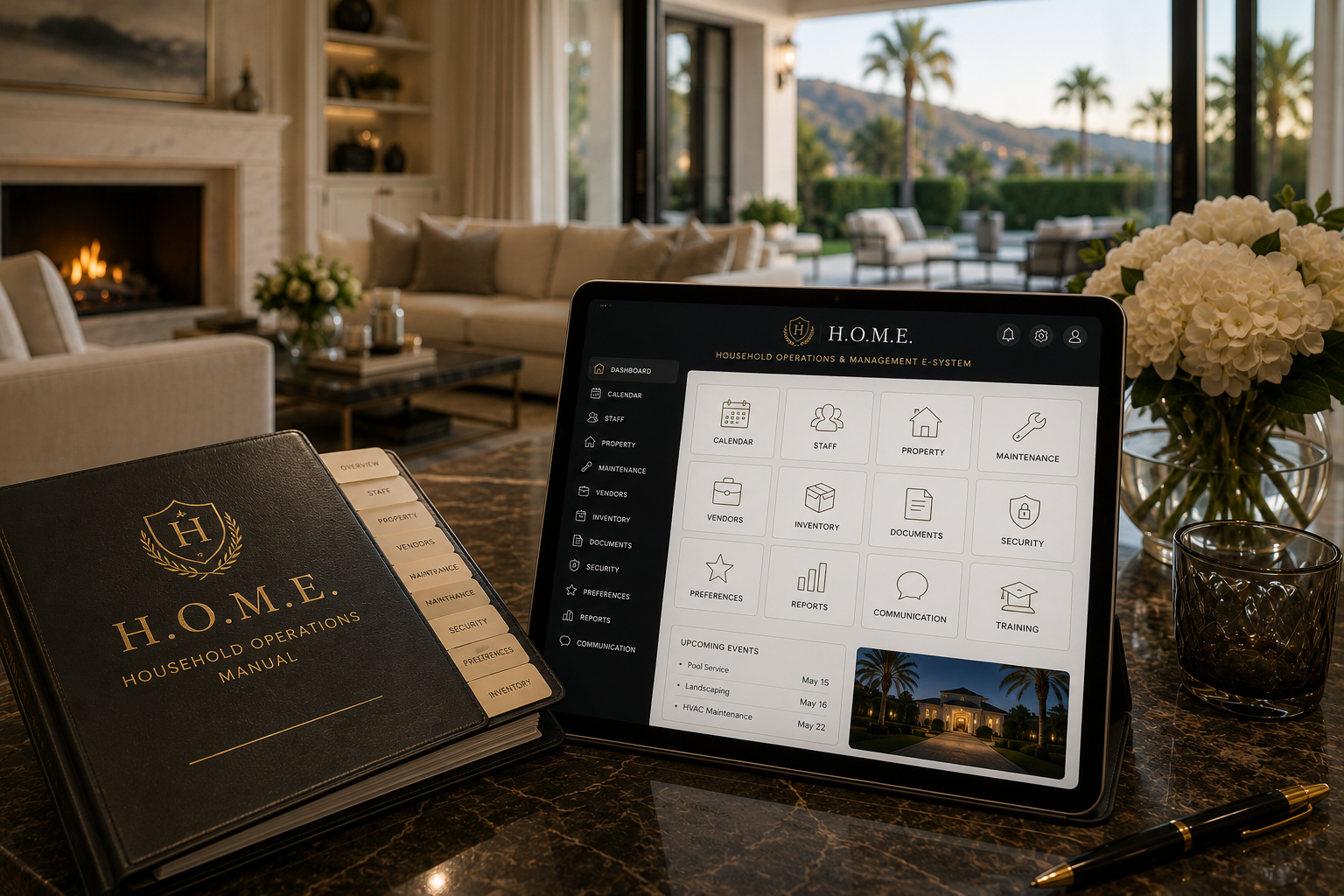
In a beautifully managed private residence, exceptional service often appears effortless.
The home is prepared before the family arrives. Preferred products are always available. Vendors know where to enter. Household staff understand their responsibilities. Maintenance happens before problems become visible. Guests are welcomed according to the family’s preferences.
Behind that apparent simplicity, however, is structure.
For complex luxury households in Los Angeles, one of the most valuable tools for creating that structure is a comprehensive household manual.
A household manual is far more than a collection of instructions. Properly developed, it becomes the operating system of the residence: a centralized resource that documents how the home functions, how service should be delivered, and how the household team works together.
What Is a Household Manual?
A household manual documents the standards, procedures, systems, preferences, and essential information required to operate a private residence consistently.
Every household is different, so every manual should be different.
Depending on the estate, it may include:
Household standards and service expectations
Staff roles and responsibilities
Daily, weekly, monthly, and seasonal procedures
Opening and closing routines
Security and safety protocols
Emergency procedures
Vendor information
Property maintenance schedules
Household inventories
Guest protocols
Vehicle information
Pet-care instructions
Preferred products and provisioning standards
Entertainment procedures
Family preferences
Important property-system information
The objective is not bureaucracy.
It is clarity.
Why Informal Knowledge Creates Risk
Many private households operate successfully because one or two experienced employees simply know how everything works.
They know which vendor services the gate.
They know how the principal prefers the guest rooms prepared.
They know which marble requires a specific cleaning product.
They know who to contact when the AV system fails.
That knowledge is extremely valuable—but when it exists only in someone's memory, the household becomes dependent on that person.
If an employee is sick, takes vacation, changes roles, or leaves the household entirely, years of operational knowledge can disappear with them.
Documented procedures create continuity.
Instead of rebuilding knowledge after every staffing change, the estate retains its operational memory.
Creating Consistency Across the Household Team
Luxury service depends on consistency.
Without clear standards, even talented employees may interpret expectations differently.
One housekeeper may prepare a room one way while another follows a completely different routine. Vendors may receive conflicting instructions. New employees may learn through observation rather than structured training.
A household manual establishes a shared reference point.
It answers a simple but important question:
How are things done in this home?
Once those expectations are documented, managers can train staff more effectively and employees can perform their roles with greater confidence.
Supporting New Employee Training
Private household environments can be complex.
New employees must learn far more than their job description. They need to understand the household culture, communication expectations, privacy standards, security procedures, property layout, family preferences, and how their role interacts with the rest of the team.
A well-designed household manual creates a foundation for onboarding.
It does not replace personal training.
It makes that training more effective.
Instead of relying entirely on verbal instructions, employees have a structured resource they can reference as they become familiar with the estate.
Protecting Privacy and Security
Documentation is particularly important in high-profile households, but access to that information must also be carefully controlled.
Household procedures may contain sensitive information regarding:
Access protocols
Security procedures
Vendor contacts
Travel-related processes
Property systems
Staff responsibilities
Valuable assets
Private household preferences
For this reason, household manuals should be organized with confidentiality in mind.
Not every employee needs access to every piece of information.
A professionally structured system allows the appropriate people to access the information required for their roles without unnecessarily distributing sensitive household details.
Managing Maintenance Before It Becomes an Emergency
A luxury estate contains numerous systems that require ongoing attention.
HVAC equipment, appliances, generators, pools, irrigation, security systems, smart-home technology, vehicles, gates, elevators, and specialty finishes all have different maintenance requirements.
When these schedules are managed informally, tasks can easily be missed.
A household operating system can centralize preventive-maintenance information so the team knows:
What needs service
When service is due
Which vendor is responsible
What work has already been completed
What follow-up may be required
Preventive management protects both the residence and the owner's time.
The best maintenance issue is often the one the homeowner never has to hear about.
Household Manuals for Multiple Residences
The need for documentation becomes even greater when a family maintains several properties.
A Malibu residence may have completely different vendors, systems, staffing requirements, security procedures, and seasonal needs from homes in Beverly Hills, Aspen, New York, or abroad.
Without centralized systems, operational information becomes fragmented.
A structured household manual for each property allows estate leadership to maintain consistent service standards while respecting the unique requirements of every residence.
The owner experiences consistency.
Behind the scenes, the operating procedures may be completely different.
A Household Manual Should Evolve
A household manual is not something that should be created once and forgotten.
Homes change.
Staff changes.
Vendors change.
Technology changes.
Family preferences evolve.
New equipment is installed and old procedures become obsolete.
The manual should therefore be treated as a living operational resource that is periodically reviewed and updated.
That is what transforms documentation into management.
The H.O.M.E. Approach
At Heritage Estate Management, our experience managing private residences led us to develop H.O.M.E.—the Household Operations and Management E-System.
H.O.M.E. provides a customizable framework for organizing household operations, procedures, staff guidance, and important property information.
Combined with personalized staff training and estate-management expertise, a structured household operating system helps create something every exceptional residence needs:
Continuity.
The family should not need to know where every manual is stored, when every system requires service, or which employee remembers a particular procedure.
The household should simply work.
Structure Behind Effortless Living
The finest private residences are not defined only by architecture, design, or amenities.
They are defined by how effortlessly they support the people who live in them.
Clear systems give household staff confidence.
Documented procedures preserve knowledge.
Preventive schedules protect the property.
And thoughtful organization allows service to remain consistent even as people and circumstances change.
That is the true purpose of a household manual.
Not more administration.
More freedom.
Heritage Estate Management creates customized household manuals, H.O.M.E. digital operating systems, and staff-training programs for private residences. Contact our team to discuss creating an operational structure tailored to your household.