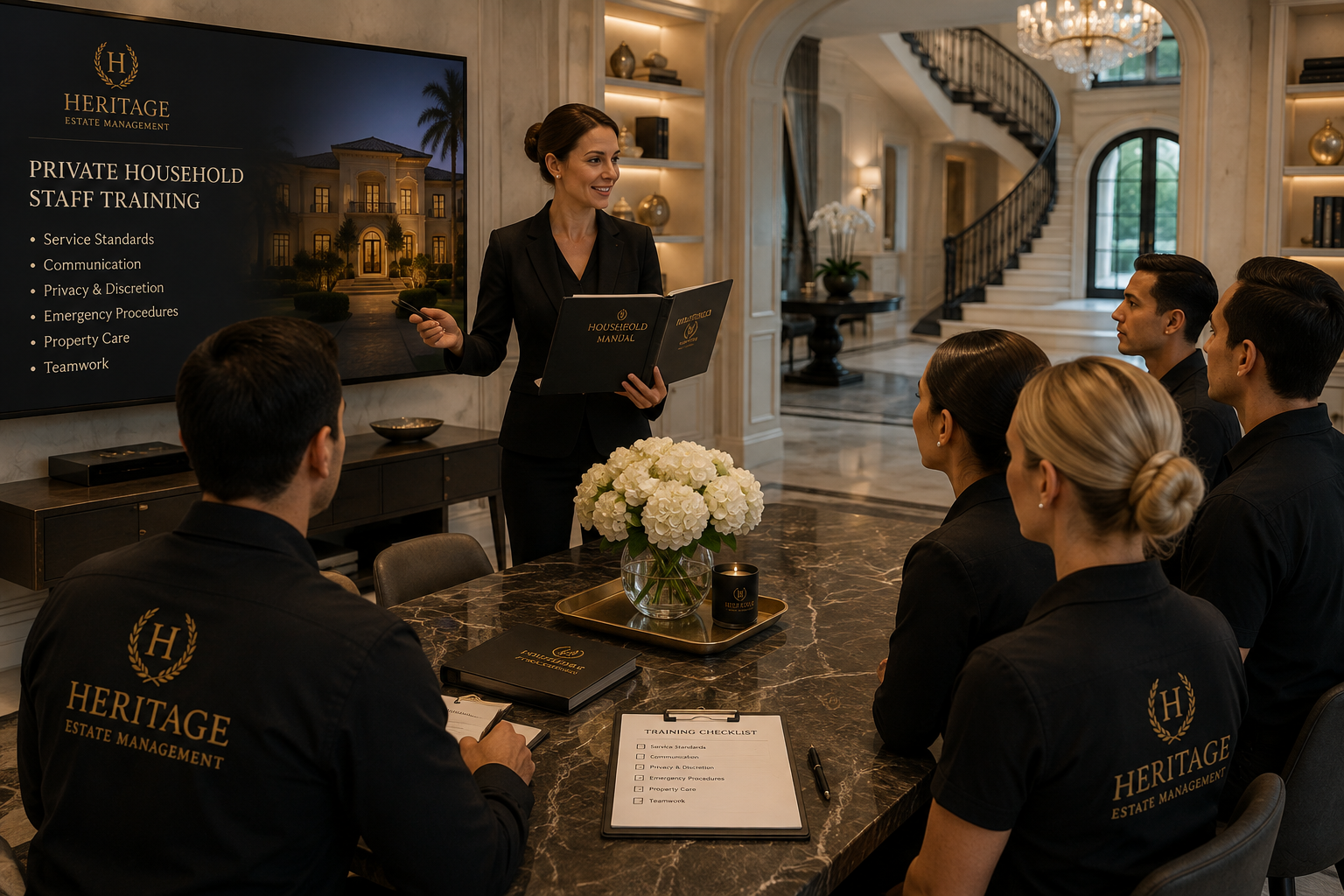
Hiring experienced household staff is important.
But experience alone does not guarantee that a team will operate successfully inside a particular home.
A housekeeper may have spent fifteen years working in exceptional residences. A private chef may have an impressive culinary background. An Estate Manager may have overseen complex properties and large teams.
Yet every private household has its own culture.
Its own standards.
Its own communication style.
Its own definition of exceptional service.
This is why staff training is one of the most important—and sometimes underestimated—elements of luxury household management.
Every Private Household Is Different
There is no universal formula for private service.
One family may prefer highly formal service.
Another may want employees to be almost invisible.
Some households entertain constantly.
Others value privacy above everything else.
Some principals want frequent updates.
Others prefer to hear only when a decision genuinely requires their attention.
Training allows employees to adapt their professional skills to the specific household they serve.
The question is not simply:
Can this person do the job?
It is:
Can this person do the job the way this household needs it done?
Start With Clear Expectations
Many household performance issues begin with ambiguity.
An employee may be hardworking and capable but still disappoint the homeowner because expectations were never clearly communicated.
What does “guest-ready” mean in this residence?
How should staff communicate with the family?
When should a maintenance concern be escalated?
Which areas require special privacy procedures?
How should vendors be received?
What information should be documented?
Training converts assumptions into standards.
When expectations are clear, employees can focus on delivering excellent service instead of trying to guess what excellence means.
Create Consistent Service Standards
Consistency is one of the defining characteristics of luxury hospitality.
The same principle applies inside a private home.
Bedrooms should be prepared consistently.
Guest arrivals should follow an established standard.
Preferred products should be stocked.
Household routines should continue regardless of which team member is working.
This becomes particularly important when several housekeepers, assistants, or rotating staff members share responsibilities.
Without training, every employee may develop their own method.
With training, individual expertise becomes part of a unified household standard.
Train Staff in Communication
Technical ability is only one component of private service.
Communication is equally important.
Household employees may need to communicate with principals, guests, other staff members, vendors, family offices, security personnel, and external professionals.
The tone and amount of communication should fit the household.
Effective training can establish:
Reporting procedures
Preferred communication channels
Escalation protocols
Shift handovers
Vendor communication
Guest interaction standards
Confidentiality expectations
Incident reporting
Good communication reduces both mistakes and unnecessary interruptions.
Privacy and Discretion Must Be Operational Standards
For high-profile families, privacy cannot simply be described as a desirable personality trait.
It needs to become part of household procedure.
Staff should understand expectations surrounding:
Personal information
Photography
Social media
Guests
Travel
Property access
Vendors
Documents
Conversations overheard inside the home
Household schedules
Discretion is strongest when expectations are explicit.
Professional employees generally want to respect the family's privacy.
Training gives them the framework to do so consistently.
Prepare Employees for Emergencies
Household staff may be among the first people required to respond when something unexpected happens at a residence.
Training should therefore include relevant emergency and safety procedures.
Employees should know where emergency supplies are located, how communication works, who should be contacted, and what responsibilities apply to their particular role.
These procedures should be documented and reviewed periodically.
During an emergency, clarity is far more useful than improvisation.
Training Protects Valuable Homes
Luxury residences contain materials and systems that require specialized care.
Natural stone, fine wood, custom textiles, artwork, antiques, specialty appliances, smart-home systems, and designer furnishings may all have unique requirements.
An employee who is excellent at general housekeeping can still unintentionally damage an expensive surface if nobody explains its proper care.
Property-specific training protects the home by ensuring staff understand what they are working with.
The same principle applies to technology and equipment.
Employees do not necessarily need to become technicians.
They need to know the correct procedures, the limits of their responsibilities, and when to contact the appropriate specialist.
Training Strengthens the Entire Team
Structured training is not about criticizing employees.
Done correctly, it gives them confidence.
Employees know what is expected.
Managers have objective standards to reference.
New team members can integrate more easily.
Responsibilities become clearer.
Misunderstandings decrease.
And strong employees have a better environment in which to succeed.
That benefits both the staff and the family.
Use the Household Manual as a Training Tool
Training is most effective when it is supported by documentation.
A household manual can preserve procedures, standards, property information, emergency protocols, and role expectations.
Instead of giving an employee dozens of verbal instructions and expecting perfect recall, the household provides a reference system.
This is particularly useful when onboarding new staff or maintaining standards across several residences.
Training teaches the standard.
Documentation preserves it.
Management reinforces it.
Training Is an Ongoing Process
Private households evolve constantly.
Family schedules change.
Children grow.
Properties are renovated.
Technology is upgraded.
New staff members join.
Service expectations evolve.
Training should evolve as well.
Short refresher sessions, updated procedures, team meetings, and periodic reviews can maintain standards without turning the household into a corporate environment.
The goal is not formality for its own sake.
It is seamless service.
Exceptional Staff Deserve Exceptional Structure
The best household professionals take pride in their work.
Giving them clear standards, thoughtful training, useful documentation, and effective leadership allows that professionalism to flourish.
A beautifully run residence is rarely the result of one extraordinary employee.
It is the result of talented people working within a structure that allows them to succeed together.
At Heritage Estate Management, our team draws on extensive private-service and Estate Director experience to help households establish service standards, operating procedures, household manuals, and personalized staff training.
Because exceptional household service should never depend on guesswork.
It should be intentional, consistent, and quietly exceptional.
Contact Heritage Estate Management to discuss customized staff training and household operating systems for your private residence.