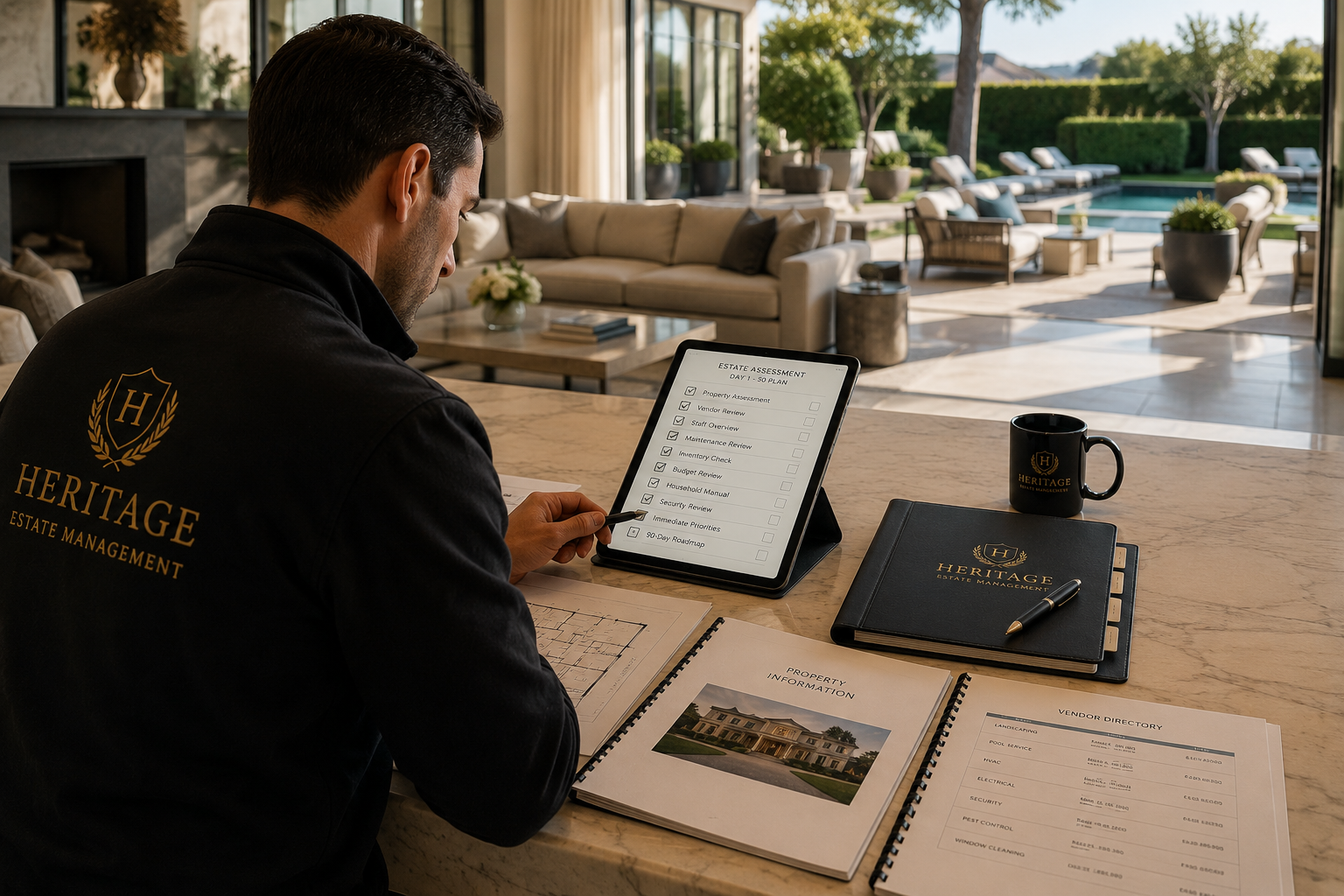
When professional management begins at a luxury residence, the first priority should not be changing everything.
It should be understanding everything.
Every private estate has developed its own ecosystem over time: household staff, vendors, property systems, maintenance routines, family preferences, budgets, inventories, security procedures, and countless unwritten habits.
Some work beautifully.
Others may have evolved without a clear structure.
The first 30 days provide an opportunity to understand that ecosystem and create a foundation for smoother, more proactive household operations.
Start With the Homeowner's Priorities
Before evaluating the property, a professional estate manager needs to understand the people who live there.
What matters most to the family?
Privacy?
Entertaining?
Frequent travel?
Children and pets?
A demanding professional schedule?
Multiple residences?
The purpose of estate management is not to impose a generic operating model.
It is to build systems around the owner's lifestyle.
A technically perfect household that does not reflect the family's preferences is not a well-managed household.
Conduct a Detailed Property Assessment
Once priorities are understood, the property itself should be reviewed.
A luxury residence may contain hundreds of operational details that are invisible during everyday living.
The assessment may consider:
HVAC and climate systems
Appliances
Plumbing and electrical systems
Security and access
Smart-home and AV technology
Pool and spa systems
Landscaping and irrigation
Vehicles
Specialty rooms and amenities
Exterior conditions
Existing maintenance schedules
Warranties and service agreements
The goal is to understand what exists, how it is currently maintained, and where additional structure may be helpful.
Map the Vendor Network
Most luxury estates rely on a surprisingly large network of outside professionals.
There may be separate vendors for landscaping, pools, HVAC, AV, security, pest control, specialty surfaces, appliances, windows, roofing, vehicles, and other systems.
During the first month, the management team should understand:
Who currently services the property
What each vendor is responsible for
How frequently they visit
Existing contracts or agreements
Current pricing
Outstanding work
Who has property access
Which relationships are performing well
The objective is not necessarily to replace vendors.
Long-standing, trusted relationships can be extremely valuable.
The goal is visibility and accountability.
Understand the Household Team
The people working inside the residence are just as important as the physical systems.
An estate manager should understand the responsibilities, schedules, communication patterns, and needs of the existing household staff.
This may include housekeepers, chefs, assistants, nannies, chauffeurs, security personnel, grounds staff, and other private-service professionals.
Often, operational problems are not caused by poor employees.
They are caused by unclear responsibilities.
Who handles a particular vendor?
Who reports maintenance concerns?
Who approves purchases?
Who prepares the residence for guests?
Clear responsibilities reduce duplication, prevent tasks from falling between roles, and allow employees to perform with confidence.
Review Preventive Maintenance
Luxury property management should be proactive rather than reactive.
During the first 30 days, existing maintenance schedules can be reviewed and organized into a comprehensive calendar.
Rather than discovering that an HVAC system has not been serviced or an appliance warranty has expired, the household begins anticipating these needs.
Preventive maintenance can reduce disruption, protect expensive systems, and create more predictable operating costs.
Most importantly, it keeps maintenance where it belongs:
Behind the scenes.
Establish Household Inventories
A professionally managed estate should have a clear understanding of important household assets and supplies.
Depending on the residence, inventories may include:
Artwork
Antiques
Silver
Furnishings
Clothing
Wine
Linens
Household supplies
Preferred toiletries
Pantry staples
Emergency supplies
Inventory systems are not simply about knowing what the family owns.
They support insurance documentation, purchasing decisions, provisioning, security, and everyday service.
Review the Household Budget
Operational clarity also requires financial clarity.
The first month provides an opportunity to understand recurring expenses, staff costs, vendor invoices, maintenance obligations, consumables, and anticipated capital needs.
The purpose is not simply to reduce spending.
Luxury estate budgeting should identify where resources are going and whether those expenditures support the standards expected by the homeowner.
A good budget provides visibility without forcing the owner into daily financial administration.
Document What Matters
As information is gathered, important operational knowledge should be organized.
Vendor contacts.
Maintenance schedules.
Household procedures.
Staff responsibilities.
Security protocols.
Property information.
Family preferences.
Emergency procedures.
This information can form the foundation of a comprehensive household manual or digital operating system.
Documentation transforms individual knowledge into household knowledge.
Identify Immediate Priorities
By the end of the initial assessment, management should be able to separate issues into categories.
Some may require immediate attention.
Others can be incorporated into preventive-maintenance schedules.
Some may simply need better documentation.
This prevents the common mistake of trying to solve every issue simultaneously.
Professional estate management is not about creating activity.
It is about establishing priorities.
Create a 90-Day Roadmap
The first 30 days should ultimately produce something extremely valuable:
A plan.
The next phase may include improving maintenance systems, formalizing vendor procedures, refining staff responsibilities, developing household manuals, organizing inventories, reviewing budgets, or preparing the property for upcoming travel and events.
Instead of reacting to whatever happens next, the household begins operating intentionally.
From Complexity to Clarity
A luxury estate may appear calm on the surface while hundreds of operational details are moving underneath.
The purpose of professional estate management is to organize those details so they stop demanding the homeowner's attention.
Understand the property.
Understand the people.
Understand the systems.
Document the knowledge.
Then build the structure required to support the family's lifestyle.
At Heritage Estate Management, our property-management process begins with understanding each residence and its owners before developing a customized strategy for household operations, maintenance, vendors, staff, and ongoing oversight.
Because exceptional estate management does not begin with doing more.
It begins with knowing exactly what needs to be done.
Contact Heritage Estate Management to discuss a customized assessment and management strategy for your Los Angeles residence.